AI for Personal Injury Firms: Tools by Case Stage
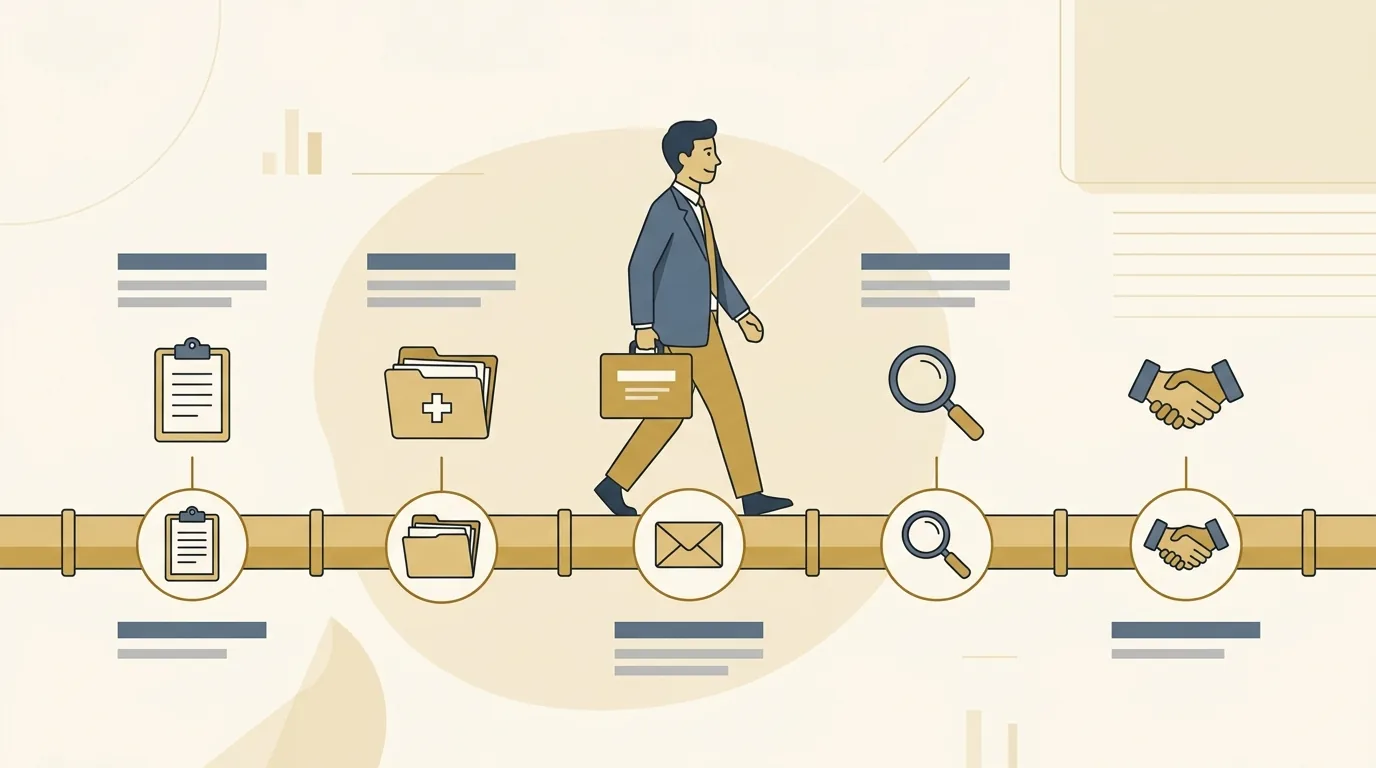
AI for personal injury law firms is not one product. It is five different software categories that map to five different points in a case: intake and case selection, medical record review and chronologies, demand package drafting, discovery and deposition work, and settlement analysis. A platform that is excellent at turning 900 pages of records into a chronology is often mediocre at running your intake pipeline, and the reverse is just as true. The right first purchase follows from which stage is actually costing you cycle time, not from which vendor ranks itself highest. Almost none of these vendors publish a price, which is the single most useful thing to know before you book the first demo.
We do not sell any of the tools below. That is the whole reason this page exists. Search the topic and the results are vendor blogs listing themselves first, second or third, which is a fine thing for a vendor to do and a poor thing for a buyer to read. What follows is organized by case stage, using tools from our verified directory, with the stages the vendor lists quietly leave out put back in.
Where does AI help a PI practice most?
The honest answer is that it helps most wherever your file is currently sitting still. In a contingency practice, cycle time is the product. Every week a file waits on a records request, a chronology, or a demand that nobody has had four uninterrupted hours to write is a week of capital tied up. AI is good at the parts of that pipeline that are high volume, document heavy, and mechanical. It is not good at the parts that require judgment about the client, the adjuster, or the venue.
Here is the map.
| Case stage | What the software actually does | Directory category | Names in our index |
|---|---|---|---|
| Case selection and lead flow | Surfaces potential claims and violations from public data, scores inbound leads | Compliance, practice management | Darrow, Lawmatics |
| Intake and matter setup | Captures leads, routes them, opens the matter, chases missing documents | Practice management | Filevine AI, Litify, Clio, MyCase |
| Medical records and billing | De-duplicates, indexes, chronologies, flags treatment gaps, extracts codes | E-discovery | Wisedocs, Supio, EvenUp |
| Demand packages | Assembles narrative, damages, exhibits, comparable settlement context | E-discovery | EvenUp, Supio, Eve |
| Written discovery | Drafts responses, requests, objections, Bates-cited production sets | E-discovery | Briefpoint, Everlaw |
| Depositions | Rough transcripts fast, transcript search, video synced clips | Depositions and court reporting | Steno, Parrot |
| Settlement and strategy | Case valuation context, judge and venue analytics | E-discovery, legal research | EvenUp, Trellis |
The stages the vendor lists skip
Read enough PI software roundups and a pattern shows up. They cover intake, records and demands, then stop. Discovery and depositions are missing, and those are two stages where a plaintiff firm spends real money.
Written discovery is mechanical enough to be a strong AI use case. Responses to interrogatories and requests for production are largely reassembly of facts the firm already has, in a rigid format, under a deadline. Briefpoint is built specifically for that and states it is used by more than 1,500 firms across all 50 states. The stakes here are set by the rules themselves: Federal Rule of Civil Procedure 26 requires damages computations in initial disclosures and imposes an ongoing duty to supplement when a response turns out to be incomplete, so the drafting tool that saves you three hours also has to be one whose output you are willing to certify.
Depositions are the other gap. Court reporting is being rebuilt around AI faster than almost any other litigation service, and for a contingency firm the cost structure matters as much as the technology. Steno pairs certified reporters with its own remote deposition platform and Transcript Genius transcript search, and offers deferred payment for contingency-fee firms, which is a genuinely PI-shaped feature rather than a generic one. Parrot, now owned by Filevine, returns AI transcript drafts synced to audio and video within 90 minutes of a proceeding. We go deeper on that whole category in AI deposition summary tools.
What handles medical records and chronologies?
This is the stage where PI firms feel the most pain and where the software is furthest along. A single soft tissue case can carry several hundred pages of records from four providers, half of them duplicates, a third of them scanned crooked. The work of sorting that is not legal work, but it blocks the legal work.
Three shapes of product compete here.
Dedicated record review sits closest to the problem. Wisedocs organizes, indexes, de-duplicates and summarizes record sets with human oversight on top of the model output, and is HIPAA compliant, which matters because you are feeding protected health information into someone else's infrastructure. That is not a formality. The ABA's first formal ethics opinion on generative AI, Formal Opinion 512, puts the duty of confidentiality under Model Rule 1.6 squarely on the lawyer regardless of the tool, so the vendor's data handling is a diligence item, not an IT detail.
Full-case platforms bundle records into everything else. Supio covers plaintiff work from intake through trial with medical chronologies and demand packages built from the same case file. EvenUp turns case files and records into demand packages and valuations. Filevine AI does record summarization inside the case management system your staff already lives in, which is a real advantage when the alternative is a fourth login.
The evaluation question is not "does it summarize." They all summarize. Ask instead what happens to the pages the model was unsure about, whether every line of the chronology links back to a source page you can open, and how the tool handles a provider's records arriving in three formats across two years. Ask for the demo to run on your own file, not the vendor's.
How do AI demand letter tools work?
An AI demand letter tool is a pipeline, not a writing assistant. In rough order it ingests the file, extracts structured facts from the records, builds a treatment chronology, computes the special damages from the bills, drafts a narrative of liability and injury, attaches the exhibits, and produces a package with the citations pointing back at the record.
The step people underestimate is the extraction, not the prose. Language models write competent demand narrative easily. Getting the ICD codes, provider names, dates of service and billed amounts out of a messy record set correctly is the hard part, and it is where the products differentiate.
Vendors also split on how much human labor they put in the loop, and they are explicit about it. EvenUp's Demands page describes two tiers: an Express demand drafted by AI in minutes that your team reviews and finalizes, and an Expert demand drafted by AI and then reviewed by EvenUp's own legal professionals, delivered finalized in one to five days. Those are the vendor's descriptions of its own service. Which tier a firm needs depends entirely on whether it has the internal review capacity to catch an error before it goes to an adjuster.
Independent work points the same direction. Stanford Law School's Justice Innovation Lab, in its Demand Letter AI project with a legal aid partner, built exactly this kind of assisted drafting flow and reports that no letter goes out without attorney approval, with the attorney checking for hallucinations, legal accuracy and completeness. That is a different practice area and a nonprofit context, but the control it lands on is the same one every PI firm needs.
One billing note from Formal Opinion 512, since it comes up in every PI firm's first AI conversation: the opinion states a lawyer may charge for the time spent inputting information and for the time reviewing the output for accuracy and completeness, but in most circumstances cannot charge a client for learning how to use the tool.
What about intake and case management?
Intake is the stage where AI money is easiest to justify and easiest to waste. Easiest to justify because response speed to an inbound injury lead is a direct conversion input. Easiest to waste because a chatbot bolted onto a broken intake process just produces the same bad outcome faster.
The category splits into two.
Legal CRM and lead automation is where Lawmatics sits, with lead capture, scoring, nurture sequences, booking and forms, plus an AI layer for qualification and follow up. Its pricing is quoted per firm rather than published.
Case management with AI built in is the bigger commitment. Filevine AI is heavily used by PI and plaintiff firms and adds record summarization and demand drafting on top of the matter system. Litify is the enterprise option, built on Salesforce, for firms that want matter management and reporting in one platform. Clio brings Manage AI into a system a huge share of small firms already run. MyCase is one of the few in this whole article with a published price, at $50 to $130 per user per month billed annually, which tells you something about how the rest of the market prices.
Upstream of intake entirely sits Darrow, which scans public data for potential legal violations and connects the resulting cases with litigators. That is case sourcing rather than case handling, and it is a different budget line with a different risk profile.
What should a PI firm pilot first?
Pick by bottleneck and by volume. Below is the decision tree I would use, reading from your open file count down to the one category to evaluate first. Run one pilot at a time. Firms that buy three platforms in a quarter end up using none of them properly.
- Under about 50 open files
- Records are the bottleneck: buy per case record review rather than a platform. Evaluate the e-discovery category for dedicated record review first, because a per matter cost matches contingency cash flow better than seats do.
- Demands are the bottleneck: evaluate a managed demand service where the vendor's own staff reviews the draft. You do not yet have the internal reviewer to make an AI-only tier safe.
- Intake is the bottleneck: fix it inside your existing practice management system before buying a CRM. Start in the practice management category.
- Roughly 50 to 300 open files
- Records and demands are both the bottleneck: this is the range where a full plaintiff platform starts to pay, because the same extraction feeds both.
- Litigated files are stacking up: written discovery drafting is the highest yield first pilot, since the volume is predictable and the output format is rigid.
- Staff turnover is the real problem: pick the tool that lives inside your case management system, not the standalone one. Adoption beats capability at this size.
- 300 or more open files
- Evaluate platforms, and demand a pilot on your own historical files with a measurable comparison against your current cycle time.
- Deposition volume is now a line item worth its own vendor. Transcript turnaround and search change litigation scheduling in a way that shows up in cycle time.
- Ask every vendor for its error handling and audit trail before you ask about features. At this volume a silent extraction error is a systemic risk, not an incident.
One rule across all three bands: the pilot has to run on your files. A demo on the vendor's clean sample record set tells you nothing about the tool's behaviour on a chiropractor's fax from 2019.
If you want the wider view across every legal AI category rather than the PI slice, start with our guide to the best AI legal tools. Otherwise, browse the e-discovery and practice management categories, which is where most PI-relevant tools sit in our index. If you run a tool that belongs here and it is missing, you can submit it at no cost.
Frequently asked questions
What AI do personal injury firms use for demand letters?
The tools most commonly named for PI demand drafting are EvenUp, Supio and Eve, plus the demand drafting built into Filevine AI for firms already running that case management system. They differ mainly in how much human review the vendor performs before the draft comes back to you and in whether the demand is a standalone product or part of a full case platform. General purpose chat models can write demand prose, but they do not extract structured damages data from a record set, which is the part that takes the time.
How much does EvenUp cost?
EvenUp does not publish a price. Its demands product page describes case based pricing and directs buyers to schedule a call, so the number depends on your volume, which tier of review you take, and the negotiation. That is the norm rather than the exception in this category: nearly every PI-focused platform in our directory is listed as pricing on request. When you do get a quote, ask whether it is priced per case or per seat, because the two structures behave very differently in a contingency practice with an uneven file count.
Can AI summarize medical records?
Yes, and record summarization is currently the most mature AI use in personal injury work. Dedicated products index, de-duplicate and chronologize record sets and pull out dates of service, providers, diagnoses and billed amounts. The output still needs verification against the source pages, which is why the better products link every chronology line back to the page it came from and why several vendors keep human reviewers in the loop. Treat the summary as a first pass produced by a non-lawyer, because that is functionally what it is.
Does AI help with PI case intake?
It helps with the mechanical parts: capturing and routing inbound leads, scoring them, chasing missing documents, booking the consultation, and keeping the follow up sequence running so a signed case does not go quiet. Legal CRM tools and AI-enabled case management systems both do this. What AI does not do is decide which cases your firm should take. That judgment depends on venue, coverage, your capacity and your risk tolerance, and no scoring model in an intake tool has enough of that context to be trusted with it.