AI Legal Transcription: Rev, Verbit, Steno Compared
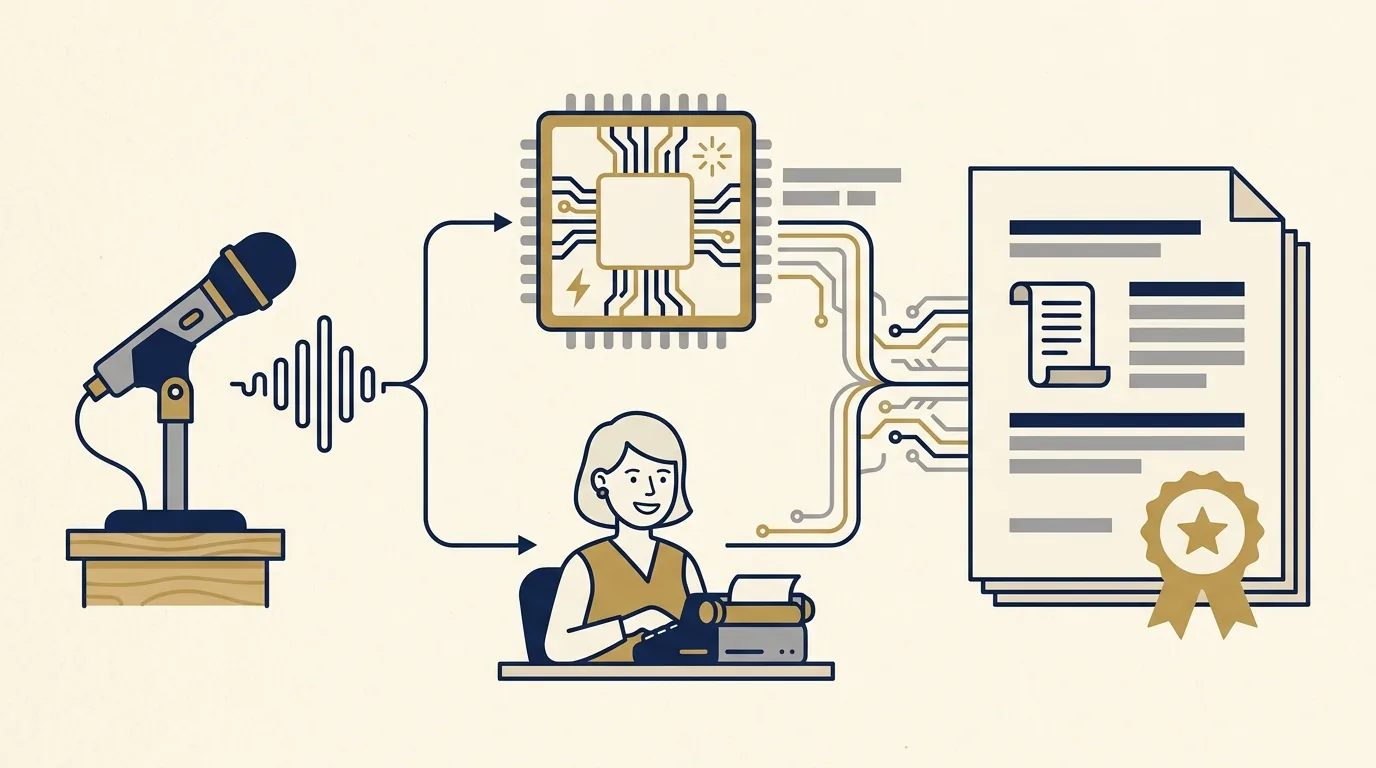
The right legal transcription software depends on one question: does the transcript have to be the record? If it does, you need a certified transcript, which means the court reporter or deposition officer attests to it, and no software can give you that on its own. If it is a working copy for case prep, an AI draft is fast and cheap. Most vendors now sell a hybrid of the two, with a machine draft first and a human-verified final later. Among the legal specialists in our directory, Rev publishes per-minute and per-page rates, Skribe publishes hourly deposition rates, Verbit publishes a self-serve plan but quotes its legal services, Steno quotes on request, and Stenograph sells software to reporters rather than transcripts to firms. Decide which model you need first. The vendor shortlist follows from that.
This is software evaluation and industry analysis, not legal advice. Rules on recording and certifying testimony differ by court and jurisdiction, so check the rules that govern your matter.
We don't sell transcription, we don't take vendor money for rankings, and every tool below is a listing in our own directory. That matters here because a lot of what gets written comparing these products is written by one of them. Every price and product claim in this post was checked against the vendor's own site on September 15, 2026.
When does a legal team need certified transcripts?
The dividing line is whether anyone will rely on the transcript as the record of what was said.
In federal civil cases, Federal Rule of Civil Procedure 30 lets the party noticing a deposition record it by audio, audiovisual or stenographic means, and that party pays the recording costs. Any party may arrange its own transcription. What turns a recording into a deposition record is the officer. Under Rule 30(f)(1), the officer must certify in writing that the witness was duly sworn and that the deposition accurately records the testimony, and the certificate travels with the record. For proceedings in federal district courts, 28 U.S.C. § 753 goes further: a transcript certified by the reporter or other designated individual is deemed prima facie a correct statement of the testimony, and no transcript counts as official unless it comes from certified records.
In practice that gives a litigation team three buckets of transcription work:
- Record transcripts. Depositions you may file or read at trial, hearings, and anything headed for an appellate record. These need certification from the person who took the record or is designated to produce it.
- Evidence transcripts. Recorded interviews, bodycam and 911 audio, recorded calls, meetings produced in discovery. Accuracy matters and a human-verified version is often worth paying for, but the transcript is usually a working aid, not the record itself.
- Internal transcripts. Client calls, dictation, witness prep, CLE recordings. Speed and confidentiality matter far more than certification.
The expensive mistake is buying one tool for all three. An AI transcript of a deposition video is excellent for the third bucket and wrong for the first, because nobody who administered the oath has attested to it.
How do AI-only, human, and hybrid models differ?
AI-only means a speech recognition engine produces the transcript and no person checks it. It is close to instant and priced as a subscription allowance. Its weak points are exactly the ones litigation exposes: crosstalk, accents, proper nouns, exhibit numbers and speaker labels. The errors are not evenly distributed either. A 2023 white paper from the National Court Reporters Association cites a Stanford study of five speech recognition systems that found an average word error rate of 0.35 for Black speakers against 0.19 for white speakers. The NCRA represents stenographic reporters and has a stake in this debate, so read it as an advocate's paper. The study it cites is still the kind of number worth putting to any vendor that quotes a single accuracy figure.
Human transcription means a trained transcriptionist produces or corrects every line. Rev prices general human transcription at $1.99 per minute with a stated 99%+ accuracy guarantee in 12 hours or less. A stenographic court reporter is a different thing again: the reporter is present, captures the proceeding live, and certifies the result.
Hybrid is where the market has settled. The machine drafts, a person verifies, and the vendor sells the draft and the verified version as separate deliverables at separate speeds. Rev's legal rough draft and premium transcript, Verbit's AI rough drafts and human final transcripts, and Skribe's same-day rough and human-verified final are all versions of the same idea. The questions that separate them are who the human is (a general transcriptionist, a legal-trained editor, or a certified reporter) and whether that person is also the officer who certifies.
Which platforms serve depositions specifically?
Here are five legal specialists from our depositions and court reporting category, compared on the four things that actually separate them. Turnaround and pricing are as each vendor states them on its own site as of September 15, 2026.
| Tool | Model | Stated turnaround | Certification path | Published pricing |
|---|---|---|---|---|
| Rev | AI, human, and legal-formatted human transcripts, sold separately | Human: 12 hours or less, rush from two hours. Legal Rough Draft: same day to 3 days. Legal Premium: same day to 5 days | Legal formatting with Q and A structure and bylines. Also sells a court reporting self-service product described as instant drafts to certify-ready transcripts | Yes. Seats from $25.49 per seat per month billed annually. Human $1.99/min. Legal transcripts $2.25 and $2.50 per page |
| Verbit | Legal speech recognition, AI rough drafts, human final transcripts | Rough drafts within 24 hours. Real-time capture through Legal Capture | Final transcripts with cover pages. Certified court reporters and certified electronic reporters can perform QC | Partly. Standard plan from $24 per month. Legal transcription services quoted |
| Steno | Certified court reporters, with AI analysis on top | Same-day delivery options | Network of certified court reporters | On request. Transcript Genius AI included free with Steno depositions |
| Stenograph | Software for reporters: Phoenix speech engine, CATalyst, MAXScribe | Real-time translation in MAXScribe. Batch processing for agencies through Phoenix OnDemand | The reporter or agency using the software certifies | Not published for Phoenix |
| Skribe | Digital reporter capture plus AI tools, human-verified finals | Same-day rough transcript. Human-verified final in 5 to 7 days | Non-stenographic record. Skribe states its digital reporters are not Certified Shorthand Reporters | Yes. $99/hour software tier. $379 per record hour live, plus $100/hour for in-person (3-hour minimum) |
Three things stand out once they sit side by side.
They come from different directions. Steno is built around a network of certified court reporters and adds AI to the transcript. Rev and Verbit are transcription companies that have built toward the deposition. Skribe is a digital reporting company that records the proceeding and sells AI analysis with it. Stenograph sits upstream of all of them, selling the writers and software that reporters use.
Skribe's model depends on the recording rules, and it says so. It states that its depositions run under rules of civil procedure permitting non-stenographic recording, and it backs that with a written policy: if a judge rejects the Skribe record for a witness in writing, it refunds the deposition and pays for a stenographer's transcript of the recording. That is a vendor promise, not a ruling, but it is specific, and it tells you the vendor knows exactly where the risk sits.
Accuracy numbers come in different units. Rev states 99%+ for human transcription and 99.7%+ for its Legal Premium Transcript. Stenograph states up to 94% accuracy for Phoenix's AI-generated rough transcripts. Those figures are not comparable. One describes a human-verified deliverable, the other a machine draft built to be edited by a reporter. Ask every vendor what its number measures and what audio it was measured on.
Once a transcript exists, the next layer is summaries, page-line digests and testimony search. Our comparison of AI deposition summary tools covers that layer, including Prevail and Parrot.
What does transcription actually cost?
This market uses four pricing units, and a quote in one is hard to compare with a quote in another.
Per minute of audio. The general transcription convention. Rev charges $1.99 per minute for human transcription and says subscribers save up to 15%. This is the natural unit for recorded evidence, interviews and calls.
Per page of transcript. The deposition convention. Rev's Legal Rough Draft is $2.25 per page and its Legal Premium Transcript is $2.50 per page, both produced by legal-trained transcriptionists. Rev also notes that legal-formatted transcription is not available on a subscription, so seat discounts do not reduce it.
Per hour of proceeding. Skribe charges $379 per record hour for a live deposition with a digital reporter, and $99 per hour for its software tier, where you upload audio or video you already have.
Per seat, with an allowance. AI transcription is now priced like software. Rev's Essentials plan is $25.49 per seat per month billed annually ($29.99 month to month) and includes 5,000 AI transcription minutes per user per month. Pro is $47.99 billed annually ($59.99 monthly) with 10,000. Verbit's Standard plan for legal professionals starts at $24 a month for 100 hours, split between 50 live and 50 post-production hours.
The honest way to compare is to price one real job. Take a full-day deposition, estimate the page count from your last comparable transcript, and ask each shortlisted vendor for a total covering capture or appearance, rough draft, certified final, video sync, expedite and copies. Copies are a real line item: Rule 30(f)(3) requires the officer to furnish a copy to any party or the deponent when paid reasonable charges. Service vendors quote per proceeding for a reason, and a low headline rate can sit next to add-ons that change the answer. Our legal AI pricing guide covers why so much of this category stays behind a demo.
How do court-reporting platforms bundle AI now?
Across the category, AI is increasingly given away with the transcript order rather than sold as its own product.
Steno includes Transcript Genius free with every Steno deposition. It answers questions about testimony, compares multiple depositions, generates custom summaries, and accepts transcripts from any source. Steno also offers DelayPay, interest-free payment deferred until case settlement, aimed at contingency firms. The AI is a reason to book the reporter.
Verbit splits its legal line into Legal Capture, a platform for court reporting agencies and digital reporters, and Legal Visor, real-time AI insight for attorneys during depositions, interviews and arbitrations. Finished transcripts get automatic summaries, issue spotting and keyword extraction. Verbit states ISO 27001 and SOC 2 compliance.
Rev came at depositions from the transcription side. It acquired SmartDepo in March 2025 and now markets deposition summaries with page and line references alongside its legal-formatted transcripts and court reporting self-service product. That deal and others like it are logged in our legal AI acquisitions tracker.
Stenograph puts AI inside the reporter's own workflow. Its Phoenix engine, built for court reporting, powers CATalyst Check It, which flags mismatches between a stenographer's translation and the audio, and MAXScribe, which handles recording, annotation, real-time translation and transcript production for digital reporters. The goal is a faster certified transcript, not a transcript without a reporter.
Skribe folds synced video, clip sharing, a real-time transcript and AI analysis into its hourly live rate.
The buying implication is simple. If your firm already books depositions, the AI you want may come free with a reporter you already pay for. If you mostly process recordings you did not create, a per-minute or seat-based tool is the cheaper route, and certification was never on the table for that work anyway.
Frequently asked questions
Is AI transcription accepted in court?
An uncertified AI transcript is generally a working document, not the record. Federal rules allow depositions to be recorded by audio or video as well as stenographically, but Rule 30(f)(1) still requires the officer to certify in writing that the deposition accurately records the testimony, and 28 U.S.C. § 753 treats a certified transcript of federal district court proceedings as prima facie correct. AI can sit inside that process, as a draft a reporter corrects or as part of a digital reporting workflow that ends in a human-verified final. Whether a particular transcript is usable depends on the rules and the court in your matter.
What does legal transcription cost per minute?
As of September 15, 2026, Rev lists human transcription at $1.99 per minute, and prices legal-formatted transcripts by the page at $2.25 for a rough draft and $2.50 for its premium transcript. AI transcription is mostly sold as a seat allowance rather than per minute: Rev's Essentials plan is $25.49 per seat per month billed annually with 5,000 AI minutes, and Verbit's Standard plan starts at $24 a month for 100 hours. Court reporting firms generally quote per proceeding.
Rev vs Verbit: which is better for depositions?
They suit different buyers. Rev is the easier purchase for a firm that wants to upload a file and order a result at a published price, with legal-formatted transcripts sold per page and seat plans for AI work. Verbit is built for organizations running capture at volume, with Legal Capture for reporting agencies and digital reporters, Legal Visor for real-time insight, and human final transcripts that certified reporters can quality-check, but most of its legal pricing is quoted. If you are noticing the deposition and need the certified record, compare both against a court reporting provider such as Steno rather than only against each other.
What is a certified transcript?
A certified transcript carries a signed statement from the person responsible for the record, usually the court reporter or officer before whom the deposition was taken, attesting that the witness was sworn and that the transcript accurately records the testimony. Under Rule 30(f)(1), that certificate must accompany the deposition record. A transcription company's accuracy guarantee is a different thing: it is a service promise about the text, not an attestation by the officer.
Transcription is the bottom layer of the deposition stack, with summaries, review and discovery drafting built on top of it. Browse the full depositions and court reporting category, then find the rest of the litigation workflow in e-discovery and litigation tools. Every listing is verified, free to be listed, and never ranked by who paid. If you build a transcription or court reporting product we don't list yet, submit it here.